One of the most frequent—and concerning—questions I receive from patients is: “Where can I find the best stem cell?”
It is an understandable question born out of hope, but the premise itself is flawed. Addressing this misconception is critical for patient safety and the preservation of genuine medical science.
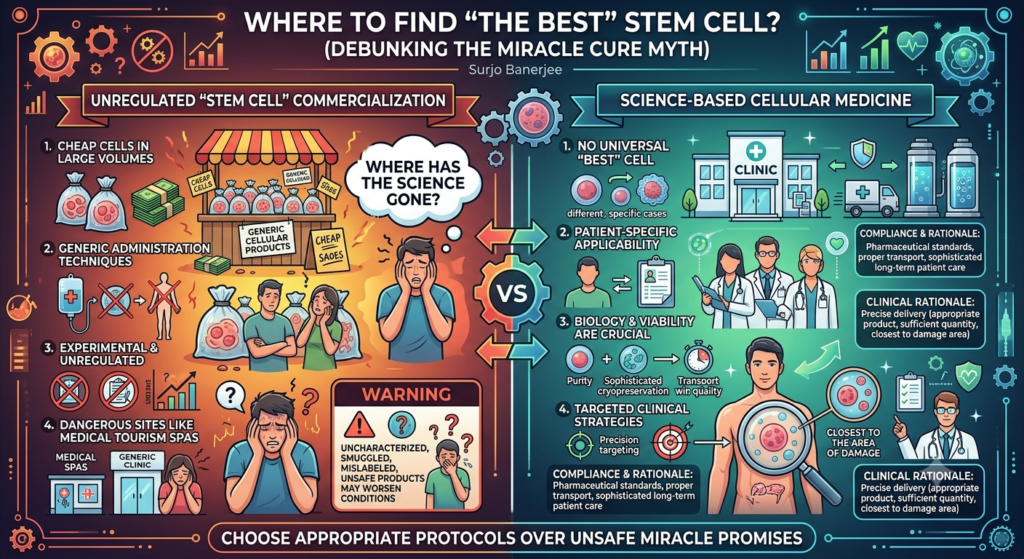
There Is No “Best” Cell
Just as there is no single “best medicine” for all ailments, there is no universal “best” stem cell. Cellular therapy is highly nuanced. Every biological product has its own specific applicability, dictated by the precise pathology it is intended to address.
Biology Dictates Efficacy
Cells are living, perishable biological entities. Their purity, viability, and characterization are paramount. Even the most theoretically appropriate cells can become entirely ineffective—or dangerously reactive—if they are not cryopreserved, transported, thawed, and administered under the strictest clinical protocols.
Precision Delivery Over Mass Volume
A legitimate clinical strategy focuses on clear, measurable goals to control or overcome a specific condition. The objective is to deliver the appropriate cellular product in sufficient, viable quantities, as close to the site of tissue damage as anatomically possible.
Clinics that sell cheap “stem cells” in massive volumes via generic, systemic administration techniques (such as simple IV drips for localized distal injuries) are not treating a patient’s condition; they are simply offloading inventory.
The Danger of the “Medical Spa”
Much of this commercialized practice falls under the umbrella of unregulated experimental medicine. We are seeing a rise in smuggled, mislabelled, and poorly characterized products posing severe safety risks to the public.
Recently, “medical spas” in popular tourism destinations have begun targeting specific, complex diseases, preying on the desperation of vulnerable patients. It is heartbreaking to watch people invest their hope and finances into the false promises and “miracles” peddled by these dubious operations. If generalized, shortcut therapies truly worked, they would not be relegated to vacation spas—they would be integrated into mainstream clinical practice globally.
A Call for Clinical Rationale
It is essential for patients to prioritize validated clinical protocols over cheap, unsafe products that risk exacerbating their conditions. True cellular medicine requires sophisticated, long-term patient management and strict adherence to pharmaceutical compliance.
Decades of meticulous work have gone into advancing clinically appropriate cell therapies. To see this field degraded into something resembling a vegetable market is a profound disservice to patients.