Deep Reset or High-Stakes Marketing?
CAR-T cell-based protocols are designed to target specific cancer glycoproteins. In MS, their scope is similar to that of existing B-cell therapies, to suppress the active B-cell population in patients. CAR-T therapies come with a significantly higher price tag than existing B-cell-depleting treatments, yet they offer outcomes only comparable to those therapies. For reference, the Kymerah CAR-T protocol costs $475,000.
The Deep Reset hypothesis currently dominates the horizon of Multiple Sclerosis treatment. The proposition is bold: using Chimeric Antigen Receptor (CAR) T-cell therapy—the powerhouse of modern oncology—to achieve what standard monoclonal antibodies (mAbs) cannot. However, as the industry pivots toward autoimmune applications, a critical question arises: Is this a genuine clinical breakthrough, or a strategic marketing expansion designed to command astronomical price points?
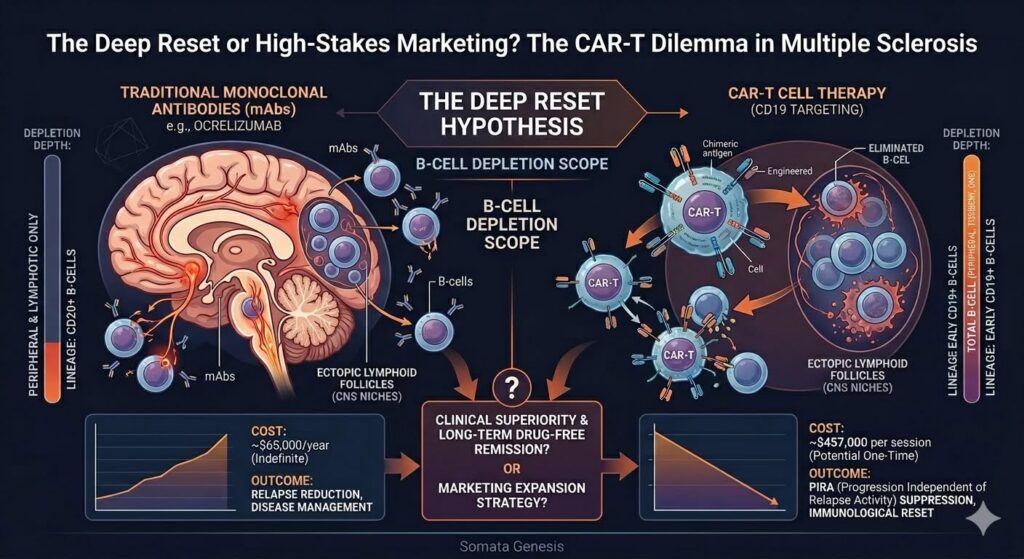
The Biological Gambit: CD19 vs. CD20
Current gold-standard B-cell depleting therapies, such as Ocrelizumab or Ofatumumab, target the CD20 surface protein. While highly effective at reducing relapse rates, these treatments have inherent limitations:
- The Sanctuary Problem: mAbs are large molecules with poor CNS penetration. They primarily clear B-cells from the blood and lymphatic system, potentially leaving smoldering inflammation within the brain’s ectopic lymphoid follicles untouched.
- Lineage Gaps: CD20 is not expressed on the earliest B-cell precursors or the long-lived, antibody-secreting plasma cells that may drive chronic disability.
CAR-T therapies typically target CD19, which spans a broader range of the B-cell lineage. Because CAR-T cells are living drug biologics, they can actively extravasate into tissues and cross the blood-brain barrier, theoretically hunting down B-cell niches that passive antibodies cannot reach.
The Economic Significance
The most significant hurdle to widespread CAR-T adoption is the staggering cost. With protocols like Kymriah priced at approximately $457,000 per session, the financial delta between cellular therapy and traditional biologics is massive.
Anti-CD20 Monoclonal Antibodies Vs CD19 CAR-T Therapy
- Annual Cost: ~$65,000 vs. ~$450,000+ (One-time)
- Administration: Semi-annual infusion vs. Lymphodepletion + specialized IV
- Mechanism: Passive depletion vs. Active, living surveillance
- Risk Profile: Infection risk (manageable) vs. CRS, ICANS, and neurotoxicity
For CAR-T to be economically viable, it must demonstrate the ability to induce permanent or multi-year drug-free remission. If patients require top-up B-cell treatments within a few years of a CAR-T infusion, the value proposition collapses into a purely marketing-driven narrative.
Clinical Necessity or Market Saturation?
The skeptical view suggests that the pharmaceutical industry is seeking a second act for CAR-T. As the hematologic malignancy market becomes crowded and patents on blockbuster mAbs begin to expire, entering the large, stable MS patient population offers a lucrative path forward.
The Deep Reset seen in early Systemic Lupus Erythematosus (SLE) trials—where patients achieved a complete reboot of their immune repertoire—is the north star for MS researchers. If CAR-T can truly eliminate the autoreactive memory B-cells sequestered in the CNS, it could shift the MS paradigm from management to remission.
Conclusion
Until head-to-head trials prove that CAR-T offers a superior clinical outcome—specifically in slowing PIRA (Progression Independent of Relapse Activity)—it remains a high-risk, high-cost alternative to existing B-cell therapies. Without objective biomarker data confirming that it clears CNS-resident B-cells more effectively than Rituximab or Ocrelizumab, the $450,000 price tag may be more indicative of a corporate expansion strategy than a medical necessity.
Peer-Reviewed Evidence
Mechanism of Action: Research confirms that CAR-T cells offer a living immunotherapy capable of antigen-specific cellular depletion that bypasses MHC restrictions, potentially penetrating the blood-brain barrier (BBB) more effectively than monoclonal antibodies (mAbs) like Ocrelizumab (Gupta et al., 2023; Samadzadeh et al., 2025).
The Sanctuary: Studies show that although anti-CD20 mAbs are effective, only 0.1–1% of circulating antibodies typically enter the CNS, leaving compartmentalized resident immune populations intact. CAR-T cells are being investigated specifically for their superior CNS biodistribution, which enables their elimination of these “inaccessible” cells (Anagnostouli et al., 2026).
The Deep Reset: Early clinical data from related autoimmune conditions like SLE suggest that CD19-directed CAR-T can induce deep B-cell depletion and drug-free remission, which researchers hope to replicate in refractory MS cases (Kuipers & Kersten, 2025; Samadzadeh et al., 2025).
Economic & Practical Hurdles: Literature acknowledges that the future of these therapies in MS is highly dependent on whether their long-term efficacy and safety can justify their high costs and technical feasibility compared to existing disease-modifying therapies (DMTs) (Anagnostouli et al., 2026).
References
Gupta, S., Simic, M., Sagan, S. A., Shepherd, C., Duecker, J., Sobel, R. A., Dandekar, R., Wu, G. F., Wu, W., Pak, J. E., Hauser, S. L., Lim, W., Wilson, M. R., & Zamvil, S. S. (2023). CAR-T cell–mediated B-cell depletion in central nervous system autoimmunity. Neurology Neuroimmunology & Neuroinflammation, 10(2), e200080.
https://doi.org/10.1212/nxi.0000000000200080 Cited by: 79
Kuipers, M. T., & Kersten, M. J. (2025). CD19-directed chimeric antigen receptor T-cell therapy: what can we learn from the hematologist? Lupus Science & Medicine, 12(1), e001157. https://doi.org/10.1136/lupus-2024-001157 Cited by: 3
Demetriou, F., & Anagnostouli, M. (2026). CAR T-Cell Immunotherapy in Neuroautoimmune Diseases: Focus on the Central Nervous System. Biomedicines, 14(2), 296. https://doi.org/10.3390/biomedicines14020296
Samadzadeh, S., Szejko, N., Hamadah, Y., Tan, W. Y., Gluscevic, S., Boldrini, V., Ricigliano, V. A. G., Hartung, H. P., Montalban, X., & ECF Young Investigators/Fellows Initiative (2025). CAR T cells as novel therapeutic strategy for multiple sclerosis and other neuroimmune disorders. Journal of neuroinflammation, 23(1), 35. https://doi.org/10.1186/s12974-025-03668-0