Underlying cardiovascular conditions can often exacerbate multiple sclerosis. Endothelial damage is a well-established autoimmune pathology; consequently, ischemic changes in both the brain and the myocardium, along with congenital heart rhythm abnormalities, frequently contribute to neurodegeneration. Crucially, this neurodegeneration can occur independently of autoimmune oligodendrocyte destruction and active demyelination.
Patients with MS often report that oxygen therapies feel subjectively beneficial, which aligns with the presence of these autoimmune-related ischemic changes in the brain. While these therapies can provide temporary improvements in neurotransmission for patients with non-fibrotic lesions, these effects do not translate into significant or durable clinical benefits.
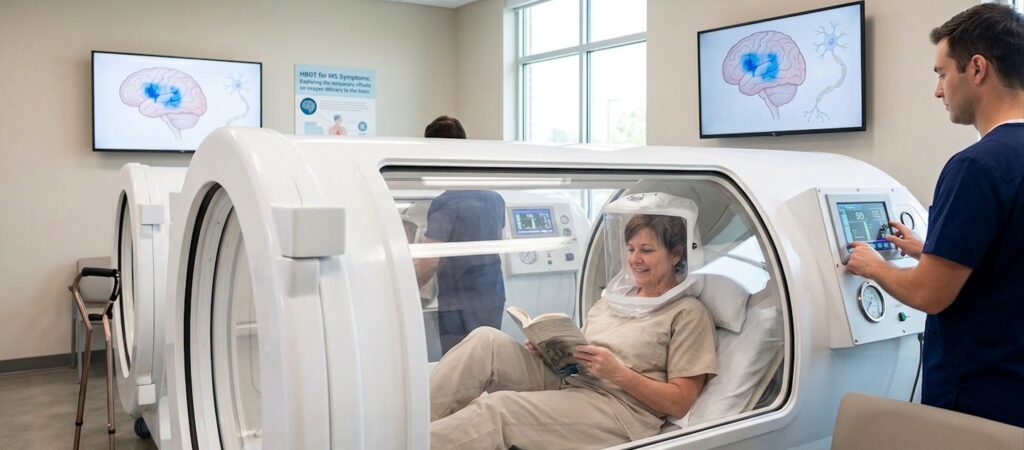
Physiological Limitations of Hyperbaric Oxygen
This limitation stems from fundamental cardiovascular physiology. The brain requires a substantial volume of oxygenated blood—approximately 20% of the body’s total supply—and dynamically modulates heart rhythm and vasodilation to meet this demand. Under normal atmospheric conditions, the blood’s capacity to carry oxygen is strictly bound by hemoglobin levels. Simply increasing oxygen saturation cannot overcome structural limits, such as anemia or cerebrovascular obstruction.
In hyperbaric oxygen therapy (HBOT), increased atmospheric pressure partially bypasses this hemoglobin limitation. According to Henry’s Law, high pressure forces oxygen to dissolve directly into the blood plasma, temporarily saturating ischemic tissues independently of standard hemoglobin transport. However, this plasma hyper-saturation is strictly transient. Once ambient pressure normalizes, the blood’s oxygen-carrying capacity immediately reverts to its baseline, which is limited by hemoglobin, meaning systemic ischemia remains unresolved.
Furthermore, ischemic conditions stemming from pulmonary obstructive or inflammatory disorders fundamentally limit normal gas exchange. Neurological or biomechanical restrictions, such as radiculopathy or costochondritis, can also impede diaphragm excursion, reducing breathing depth and further compromising oxygenation. In these specific scenarios, oxygen supplementation is highly beneficial for alleviating hypoxic stress and supporting organ function by reducing systemic inflammation. Yet, the physiological benefits remain strictly confined to the duration of active oxygen administration.
In conclusion, while oxygen therapies may mitigate specific clinical conditions that impair gas exchange at the pulmonary level, their efficacy in addressing underlying blood disorders or structural cardiovascular limitations is negligible. Even under hyperbaric conditions—where plasma oxygen dissolution provides temporary relief to ischemic tissues—the clinical benefits do not persist beyond the treatment session. Therefore, oxygen therapies should be classified as a palliative measure to relieve acute hypoxic stress, rather than a durable, disease-modifying intervention for MS or a viable clinical solution for chronic organ ischemia.
By Surjo Banerjee, Senior Neurobiologist, Somata Genesis
References
Bennett, M., & Heard, R. (2010). Hyperbaric Oxygen Therapy for Multiple Sclerosis. CNS Neuroscience & Therapeutics, 16, 115–124. https://doi.org/10.1111/j.1755-5949.2009.00129.x
Fife, C. E., Eckert, K. A., & Carter, M. J. (2016). An Update on the Appropriate Role for Hyperbaric Oxygen: Indications and Evidence. Plastic & Reconstructive Surgery, 138, 107S–116S. https://doi.org/10.1097/prs.0000000000002714
Haider, L. (2015). Inflammation, Iron, Energy Failure, and Oxidative Stress in the Pathogenesis of Multiple Sclerosis. Oxidative Medicine and Cellular Longevity, 2015, 1–10. https://doi.org/10.1155/2015/725370
Lindenmann, J., Kamolz, L., Graier, W., Smolle, J., & Smolle-Juettner, F.-M. (2022). Hyperbaric Oxygen Therapy and Tissue Regeneration: A Literature Survey. Biomedicines, 10, 3145.
Ortega, M. A., Fraile-Martinez, O., García-Montero, C., Callejón-Peláez, E., Sáez, M. A., Álvarez-Mon, M. A., García-Honduvilla, N., Monserrat, J., Álvarez-Mon, M., Bujan, J., & Canals, M. L. (2021). A General Overview on the Hyperbaric Oxygen Therapy: Applications, Mechanisms and Translational Opportunities. Medicina, 57, 864. https://doi.org/10.3390/medicina57090864
#MultipleSclerosis #MS #MSResearch #HBOT #HyperbaricOxygenTherapy #OxygenTherapy#HyperbaricMedicine #SomataGenesis
#Neurology #Neurodegeneration #Physiology #CardiovascularHealth #Ischemia #Pathology#HenrysLaw #GasExchange
#EvidenceBasedMedicine #ClinicalResearch #MedEd #HealthcareScience#TranslationalMedicine #MedicalResearch