Maladaptive Repair
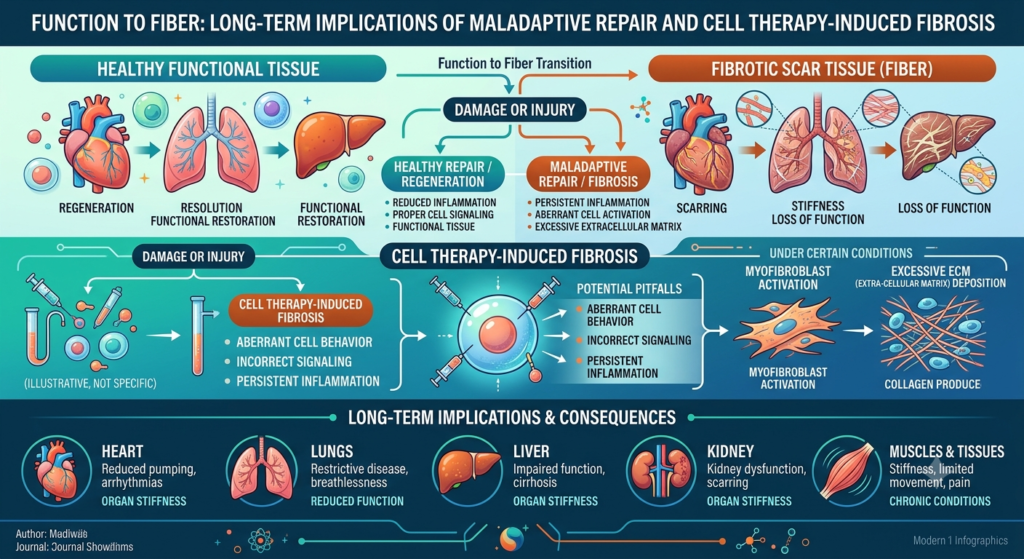
The ultimate goal of regenerative medicine is the restoration of native parenchymal function. However, a critical risk exists in the administration of poorly characterized multipotent cells: the induction of maladaptive repair, wherein inflamed, functional tissue is permanently converted into non-functional fibrotic scar tissue.
Aberrant Differentiation and the FOP Paradigm
An extreme biological precedent for errant multipotent cell behavior is Fibrodysplasia Ossificans Progressiva (FOP). Often referred to as “stone man disease,” FOP is characterized by aggressive fibroproliferative lesions that eventually undergo heterotopic ossification, locking joints and destroying mobility. While FOP is genetically driven, it serves as a profound cautionary model for regenerative medicine, illustrating the catastrophic consequences of multipotent cells differentiating into rigid structural tissue rather than functional parenchyma.
The Risk of Fibrogenic Cell Populations
In a healthy state, multipotent populations—such as mesenchymal stromal cells (MSCs) and hematopoietic stem cells (HSCs)—exist in a finely tuned rheostatic balance. However, in the context of autologous and allogeneic cellular transplants, the introduction of unpurified or inappropriate cell populations can be highly detrimental. Specifically, certain hematopoietic lineages (such as circulating fibrocytes) can respond to pro-inflammatory cytokines not by regenerating tissue, but by mediating dense extracellular matrix (ECM) deposition.
In aging bodies or environments of chronic inflammation where true tissue regeneration is biologically exhausted, these cells default to fibrotic repair. Initially, this fibrotic transformation may masquerade as a therapeutic success: the acute inflammatory cascade ceases as the inflamed tissue is replaced by stiff, non-inflammatory collagenous fiber. Yet, as the native architecture is lost, secondary symptoms of organ failure, vascular insufficiency, or musculoskeletal stiffness inevitably manifest. The inflammation has been “soothed” only because the tissue has been rendered biologically inert.
Neurological Consequences of Induced Fibrosis
The consequences of induced fibrosis are particularly devastating within the nervous system. When unchecked fibroproliferative responses occur following peripheral nerve distress, dense endoneurial scarring physical blocks axonal growth cones. This fibrotic barrier prevents reinnervation, culminating in permanent peripheral neuron loss and subsequent downstream muscle atrophy. The patient may experience an alleviation of neuropathy and pain, but at the irreversible cost of paralysis and functional tissue death.
The Eradication of Chemotactic Homing Gradients
Furthermore, fibrotic conversion actively sabotages future therapeutic interventions. Stem cell homing relies heavily on active chemotactic gradients—specifically the sustained release of pro-inflammatory and regenerative cytokines (e.g., SDF-1, TNF-?) from the target tissue. Once a tissue undergoes fibrotic transformation, it becomes chemotactically “cold.” The dense structural fiber ceases to broadcast homing signals, rendering any future systemic cellular therapies blind to the site of injury and incapable of localizing for repair.
Conclusion
Therapeutic efficacy requires absolute precision in cellular applicability. The generalized administration of “random cell lines” or poorly characterized mononuclear fractions carries the severe, long-term risk of accelerated tissue aging and induced fibrosis. To ensure true functional regeneration rather than mere structural patching, clinicians and researchers must rigorously select and validate cell populations, actively mitigating the risk of transforming vital function into lifeless fiber.
References
Di Summa, P.G., Schiraldi, L., Cherubino, M., Oranges, C.M., Kalbermatten, D.F., Raffoul, W. and Madduri, S. (2018), Adipose Derived Stem Cells Reduce Fibrosis and Promote Nerve Regeneration in Rats. Anat. Rec., 301: 1714-1721. https://doi.org/10.1002/ar.23841
Antje Moeller, Sarah E. Gilpin, Kjetil Ask, Gerard Cox, Deborah Cook, Jack Gauldie, Peter J. Margetts, Laszlo Farkas, Julian Dobranowski, Colm Boylan, Paul M. O’Byrne, Robert M. Strieter, Martin Kolb, Circulating Fibrocytes Are an Indicator of Poor Prognosis in Idiopathic Pulmonary Fibrosis, American Journal of Respiratory and Critical Care Medicine, Volume 179, Issue 7, April 2009, Pages 588–594, https://doi.org/10.1164/rccm.200810-1534OC
Shore, E.M. (2012), Fibrodysplasia ossificans progressiva: a human genetic disorder of extraskeletal bone formation, or—how does one tissue become another?. WIREs Dev Biol, 1: 153-165. https://doi.org/10.1002/wdev.9