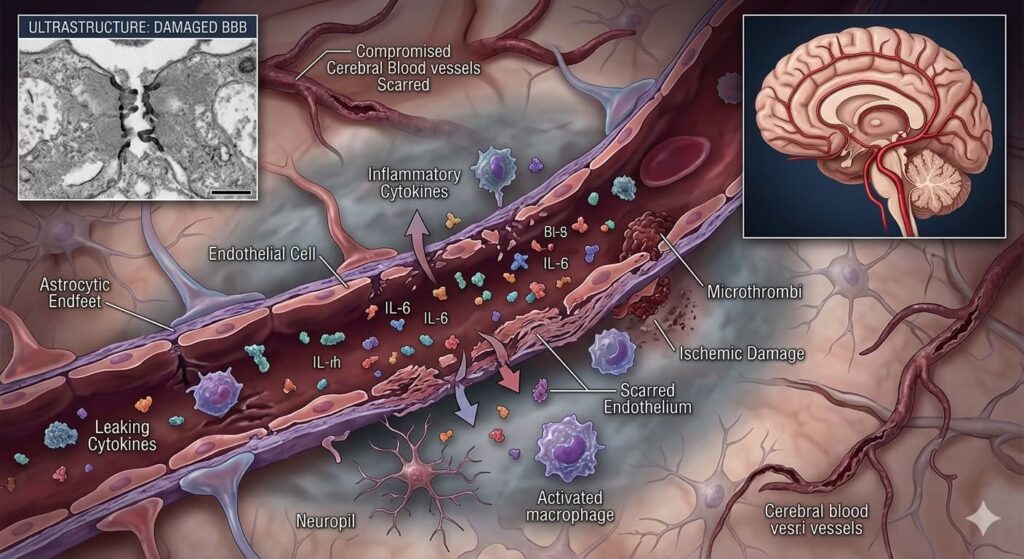
The neurological legacy of COVID-19 is increasingly understood not as a single event, but as a cascading failure of the body’s internal defenses. At the center of this crisis is hypercytokinemia—the “cytokine storm”—which can trigger a persistent autoimmune response. While much of the early clinical focus remained on pulmonary health, a more insidious form of damage has emerged: the scarring of the endothelial lining within the cerebral blood vessels.
THE ENDOTHELIAL BREAKING POINT
The endothelium serves as the critical interface between circulating blood and the vessel wall. When an autoimmune response targets this layer, it leads to chronic inflammation and subsequent scarring. In the brain, this degradation disrupts the blood-brain barrier and compromises the delivery of oxygen and nutrients.
On a brain MRI, the results are often stark. Patients frequently present with:
- Ischemic lesion loads: Areas where blood flow has been restricted, leading to tissue death.
- Increased intracranial pressure: A byproduct of vascular dysfunction and compromised fluid regulation.
- Cerebrovascular scarring: Structural changes that impede the brain’s natural ability to self-repair.
A NEW FRONTIER: SELECTIVE CEREBROVASCULAR ADMINISTRATION
Traditional systemic therapies often struggle to bypass the blood-brain barrier in concentrations high enough to reverse deep-seated vascular scarring. This has led to the development of highly specialized interventions designed to treat the damage at its source.
Somata Genesis currently stands as a pioneer in this field, utilizing selective cerebrovascular cellular administrations directly into the brain. This approach moves beyond managing symptoms, aiming instead to fundamentally rewire the damaged environment through four key therapeutic pillars:
- Immune Modulation: Calming the overactive autoimmune response to prevent further endothelial degradation.
- Angiogenesis: Stimulating the growth of new, healthy blood vessels to bypass scarred or blocked pathways.
- Neurogenesis: Encouraging the birth of new neurons to replace those lost to ischemia.
- Neuroplasticity: Strengthening existing neural connections to restore cognitive and motor functions.
MEASURING SUCCESS: BASELINE TO POST-THERAPEUTIC ANALYSIS
The efficacy of these cellular administrations is verified through rigorous, side-by-side comparisons of brain scans. By tracking subjects from a baseline of high ischemic load to post-therapeutic assessment, researchers can visualize the physical restoration of the cerebral landscape.
As we move further into the post-pandemic era, understanding the relationship between systemic inflammation and brain health is paramount. The shift toward direct, localized cellular therapy offers a promising roadmap for patients who previously had few options for reversing permanent cerebrovascular damage.