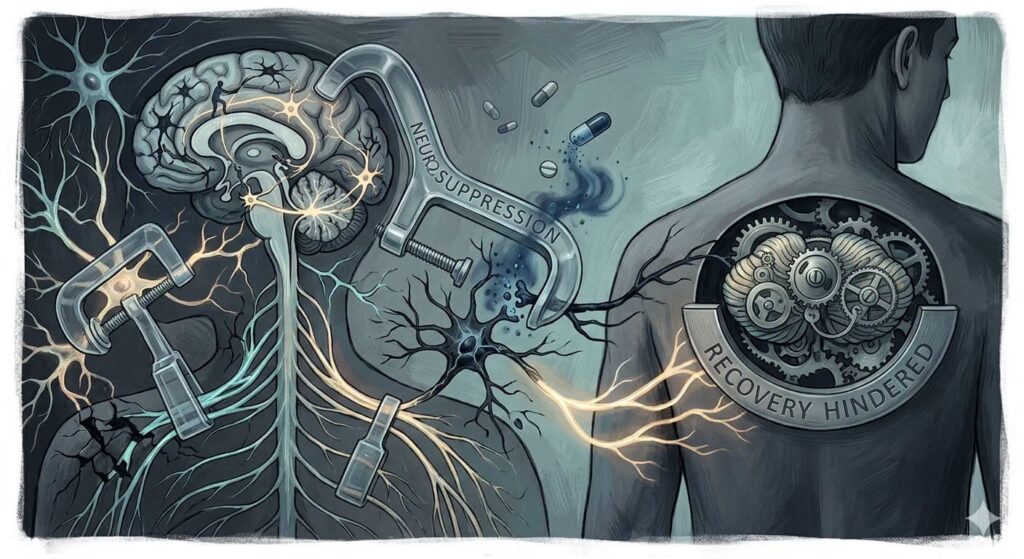
In the clinical management of Multiple Sclerosis, physicians and patients frequently encounter a profound therapeutic paradox: the trade-off between immediate symptom suppression and long-term functional recovery. To manage the anxiety, sleep disturbances, and painful spasticity associated with MS, medicine relies heavily on neuromodulating and neurosuppressive therapies.
However, clamping down on central nervous system (CNS) neurotransmission to quiet overactive symptoms can inadvertently dull the processing speed of a brain already fighting an uphill battle against demyelination. Understanding the exact cellular mechanics of these drugs reveals how they alter the electrochemical landscape and why they can mimic or exacerbate MS progression.
1. The Cellular Mechanics of Suppressive Therapies
To accurately assess the long-term impact of central nervous system depressants, it is essential to trace their exact synaptic interactions. These drugs do not simply turn down a volume knob; they fundamentally alter receptor dynamics and ion concentrations.
Benzodiazepines and GABAA? Dynamics
A common misconception is that benzodiazepines increase the production or synthesis of GABA (?-aminobutyric acid) (GABA), the brain’s primary inhibitory neurotransmitter. In reality, benzodiazepines act as positive allosteric modulators at the GABAA? receptor complex.
Benzodiazepine+GABAA??Increased Cl?Influx?Hyperpolarization
By binding to a specific site distinct from where GABA attaches, benzodiazepines alter the receptor’s conformation. This change causes the intrinsic chloride (Cl?)channel to open more frequently or remain open longer when native GABA binds. The resulting surge of negative ions hyperpolarizes the neuron, making it significantly harder to fire an action potential.
The primary clinical risk is not an overabundance of GABA, but rather cellular adaptation. Over time, the brain downregulates these receptors to maintain balance, driving severe physical dependency and the notoriously difficult tapering cycles associated with the drug class.
SSRIs and Competitive Transporter Inhibition
Selective Serotonin Reuptake Inhibitors (SSRIs) are frequently prescribed to manage the mood disorders that accompany chronic neurological disease. While sometimes colloquially described as damaging the brain’s recycling machinery, SSRIs actually engage in competitive inhibition of the Serotonin Transporter (SERT).
By physically blocking this clearance protein, the drug prevents serotonin from being vacuumed back into the presynaptic neuron. Serotonin lingers in the synaptic cleft for an extended duration, increasing its availability to post-synaptic receptors.
However, the chronic presence of excess serotonin prompts the brain to adapt by downregulating post-synaptic serotonin receptors (such as 5-HT1A?). When a patient attempts to discontinue the medication, the sudden drop in available serotonin against a backdrop of depleted receptors triggers antidepressant discontinuation syndrome. The resulting neurological turbulence can easily be misidentified as an acute MS flare-up.
Gabapentin: Attenuating Excitation
Gabapentin is widely utilized to combat the burning neuropathy and spasticity of MS. Despite its chemical name, gabapentin does not bind to GABA receptors, nor does it mimic GABAergic inhibition.
Instead, gabapentin binds with high affinity to the ?2??-1 subunit of voltage-gated calcium channels (VGCCs) on presynaptic neurons. By interfering with these channels, it reduces the influx of calcium necessary to trigger the exocytosis (release) of excitatory neurotransmitters like glutamate. Thus, while the global clinical effect is inhibitory, the mechanism is achieved by reducing excitation rather than amplifying native inhibition.
2. The Cerebellar Dilemma: Compensation vs. Suppression
When demyelination disrupts primary cortical pathways in an MS-affected brain, the central nervous system relies heavily on neuroplasticity and cerebellar compensation to reroute motor signals, stabilize coordination, and recover lost muscle function. This biological recovery effort directly collides with systemic neurosuppressive therapies.
When medications like gabapentin, baclofen, or benzodiazepines are introduced to quiet spinal hyper-reflexia and muscle spasms, they do not act exclusively on the injured pathways. Because these compounds freely cross the blood-brain barrier, their inhibitory influence is global.
- Blunting Neuroplasticity: Rerouting motor commands requires long-term potentiation (LTP)—the strengthening of synapses based on recent patterns of activity. Global dampening agents reduce overall synaptic transmission, directly hindering the cerebellum’s ability to forge these essential compensatory pathways.
- Compounding Cognitive Deficits: An MS patient already expends massive metabolic energy to conduct electrical signals over naked, demyelinated axons, resulting in baseline fatigue. Introducing global CNS depressants compounds this deficit, slowing processing speed and manifesting as profound brain fog.
3. Disentangling Disease Progression from Drug Overlay
One of the most complex challenges in modern neurology is separating the baseline symptoms of MS from the side effects of its treatment.
Primary Driver: Immune-mediated inflammation and high metabolic cost of demyelinated axonal conduction. Global reduction in synaptic transmission and altered receptor densities.
Cognitive Effect: Intermittent processing delays during inflammation or heat stress. Sustained, uniform reduction in processing speed and memory recall.
Resolution: May improve following relapse recovery or disease-modifying therapy. Resolves only through systematic, gradual pharmacological tapering.
Because the baseline fatigue of MS is structural and metabolic, layering a systemic inhibitor on top creates a secondary, drug-induced cognitive deficit. This pharmacological overlay frequently masquerades as disease progression, making objective clinical evaluation exceptionally difficult.
Clinical Takeaway: In the effort to silence painful neuropathies and muscle spasms, systemic suppression can inadvertently disable the central nervous system’s native mechanisms of self-repair.
Conclusion
Managing the complex ecosystem of an MS-affected brain requires a highly cautious, biomarker-conscious approach to psychiatric and neuromodulatory prescriptions. Because the central nervous system rapidly alters its internal architecture to adapt to these drugs, therapies should not be stopped abruptly.
Preventing severe withdrawal and distinguishing drug discontinuation from an active MS relapse requires exceptionally slow, calculated tapering protocols that allow the electrochemical framework of the synapse time to safely recalibrate.
By Surjo Banerjee, Senior Neurobiologist
REFERENCES
Arredondo-Robles, A. V., Rodríguez-López, K. P., & Ávila-Avilés, R. D. (2025). Clinical Management in Multiple Sclerosis. Neuroglia, 6(1), 6. https://doi.org/10.3390/neuroglia6010006
Gklinos, P., Christodoulou, G., Pournara, D., Evangelopoulos, M. E., & Mitsikostas, D. D. (2026). Chronic Pain in Multiple Sclerosis: Mechanisms, Clinical Characteristics and Treatment Strategies. International journal of molecular sciences, 27(2), 873.
Wasowski, C., & Marder, M. (2012). Flavonoids as GABAA receptor ligands: the whole story? Journal of Experimental Pharmacology, 4, 9–24. https://doi.org/10.2147/JEP.S23105
Olsen R. W. (2018). GABAA receptor: Positive and negative allosteric modulators. Neuropharmacology, 136(Pt A), 10–22. https://doi.org/10.1016/j.neuropharm.2018.01.036
Sancar, F., & Czajkowski, C. (2011). Allosteric modulators induce distinct movements at the GABA-binding site interface of the GABA-A receptor. Neuropharmacology, 60(2-3), 520–528. https://doi.org/10.1016/j.neuropharm.2010.11.009
Vega Alanis, B. A., Iorio, M. T., Silva, L. L., Bampali, K., Ernst, M., Schnürch, M., & Mihovilovic, M. D. (2020). Allosteric GABAA Receptor Modulators-A Review on the Most Recent Heterocyclic Chemotypes and Their Synthetic Accessibility. Molecules (Basel, Switzerland), 25(4), 999. https://doi.org/10.3390/molecules25040999