In modern regenerative medicine, “stem cells” and “exosomes” have become trending buzzwords. However, these are broad biological classifications, not uniform treatments. To evaluate them safely, they require precise specification, characterization, and strict clinical rationale.
1. DEFINING THE ENTITIES: CELLS VS. CARGO
The medical “magic” does not exist. Every therapeutic biological agent operates via a defined mechanism of action, heavily dependent on its structural integrity and processing history.
- Stem Cells: This term covers a diverse spectrum of cells capable of self-renewal and differentiation into specific tissue lineages. Their therapeutic viability, target dose, and post-administration survival depend entirely on the specific pathology being treated, the source of harvest, and the handling protocols. Because they are living entities, their viability at the moment of delivery dictates clinical outcome.
- Exosomes: These are not cells, but nanoscale extracellular vesicles. Specialized cells secrete them to act as a paracrine communication network, transferring specific proteins, lipids, and genetic material (RNA) to recipient cells. In a therapeutic context, knowing the exact cargo profile at the time of harvest is non-negotiable.
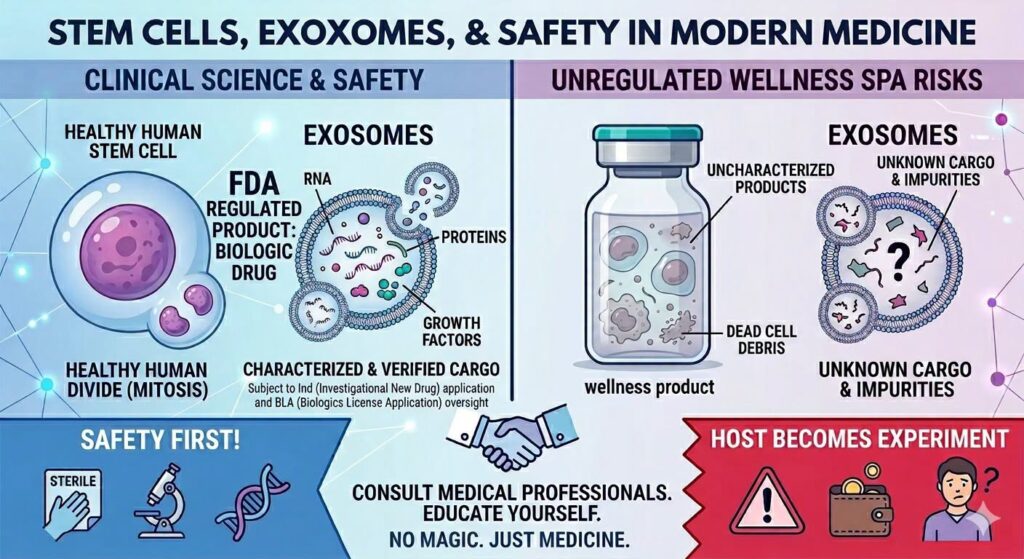
2. THE WELLNESS LANDSCAPE: THE DANGER OF “UNCHARACTERIZED” PRODUCTS
The primary hazard exists in unregulated, non-clinical environments—such as wellness spas—where these advanced biological terms are used to market uncharacterized products.
The Red Flag: In these settings, offerings and tiered pricing structures are often tailored to the customer’s purchasing power rather than to the product’s biological standard or clinical necessity.
These commercial mixtures frequently consist of poorly defined human tissue harvests, amniotic fluids, or generic growth factors. Because they bypass rigorous regulatory oversight, consumers cease to be patients and effectively become unmonitored subjects in an uncontrolled experiment.
3. THE PATHOPHYSIOLOGICAL RISKS
Administering uncharacterized biological materials introduces profound systemic risks that wellness clinics are rarely equipped to manage or even identify:
- Immunogenic Reactivity: Contamination from donor blood components, unmatched immune cells, or alien HLA (human leukocyte antigen) markers can trigger severe immune responses.
- Cellular Debris Toxicity: If handling and the cold chain are compromised, “live cell” therapies become slurries of dead cellular debris. The host organism must clear this debris, often triggering acute localized or systemic inflammation.
- Unintended Paracrine Cascades: Exosomes derived from unverified sources may carry unfamiliar proteins or foreign microRNA. Once introduced, they can alter host-cell behavior in entirely unpredictable and harmful ways.
4. THE CLINICAL STANDARD: SAFETY FIRST
Before considering any advanced cellular or vesicular therapy, the priority must always be a deep understanding of the specific disorder and a rigorous evaluation of whether a biological product is truly appropriate.
A legitimate clinical workflow must satisfy three foundational pillars:
- Purity & Verification: Complete characterization of the cellular line or vesicle cargo; certified sterile and free of donor cell contamination.
- Administration Protocol: Targeted, precise delivery techniques managed by qualified specialists in a controlled clinical environment.
- Mechanistic Rationale: A proven, evidence-based connection between the product’s mechanism of action and the patient’s specific pathology.
The Bottom Line: Protect yourself by demanding transparency. Request exact product specifications, verify the manufacturing source’s regulatory compliance, and prioritize objective medical guidance over commercial marketing.