What Patients and Caregivers Both Need to Know
A multiple sclerosis diagnosis doesn’t arrive alone. It enters a marriage, a partnership, a shared life — and it changes everything, often before either person fully understands what is happening.
For couples navigating a new MS diagnosis, the early period can feel disorienting and isolating in equal measure. The person diagnosed may seem to pull away. The spouse who steps into the role of caregiver may feel unseen or shut out. Neither experience is a failure of love. Both are predictable responses to an unpredictable crisis — and understanding why they happen is the first step toward finding each other again on the other side.
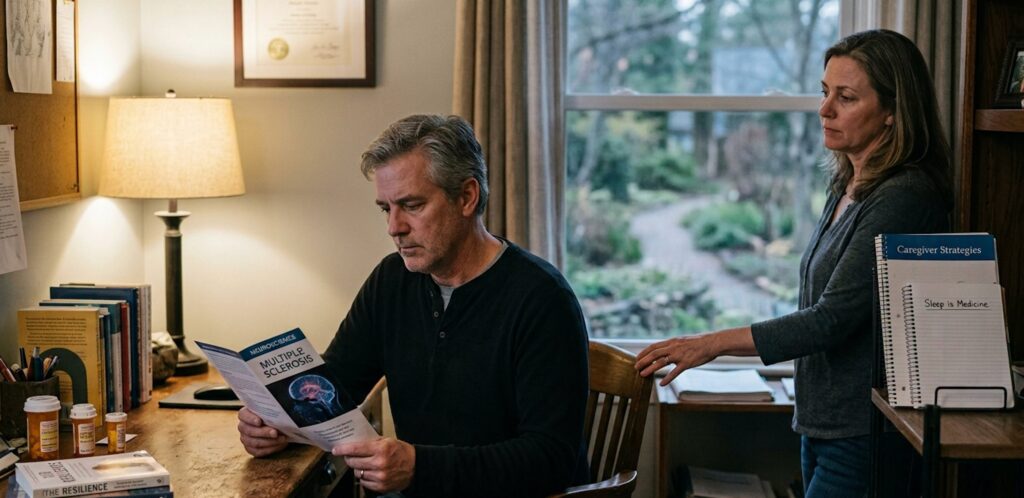
Why the Newly Diagnosed Partner Seems to Pull Away
One of the most confusing early experiences for a caregiving spouse is watching their partner appear to become emotionally distant, self-focused, or even dismissive — at the exact moment when closeness and mutual support seem most needed.
This is not entitlement. It is neurochemistry.
When the brain perceives a serious threat — and a life-altering diagnosis qualifies — it shifts into survival mode. The sympathetic nervous system activates the fight-or-flight response, flooding the body with stress hormones like adrenaline and cortisol. Heart rate rises. Breathing quickens. The brain narrows its focus to the immediate threat, and emotional connection takes a back seat to self-preservation.
MS adds additional layers to this response. The disease’s neuroinflammatory process can increase GABA production, a neurotransmitter that slows neural activity. This can result in dampened emotional responsiveness, personality changes, and prolonged periods of numbness. Sleep disruption, cortisol-driven stress, and neuroendocrine shifts further compound the effect.
In practical terms, the person you married is still there, but their brain is temporarily operating in a mode that prioritizes survival over relationship. The emotional withdrawal that looks like rejection is, at a neurological level, the brain preparing for an uncertain road ahead — often before the person is consciously aware of it.
Male patients, in particular, tend to need more time to process the diagnosis, to stop pushing others away, and to recognize what kind of help they actually need. This is not stubbornness. It reflects how stress and identity threat are often processed differently across gender socialization and neurobiological patterns.
What the Caregiving Spouse Is Going Through
MS affects caregivers profoundly — and that impact is frequently underestimated, including by the patients themselves.
When cognitive deficits, emotional numbness, and survival-mode behavior dominate the early post-diagnosis period, the caregiving partner’s contributions often go unacknowledged. They are managing the household, absorbing emotional outbursts, researching treatment options, and doing all of this while grieving their own version of the loss: the relationship they had before, the future they had planned, the partner who used to show up differently.
That grief is real. So is the frustration. And when those feelings collide with a partner who seems oblivious to their sacrifice, the risk of premature separation rises — before the new shape of the relationship has had a chance to form.
Understanding what is driving the patient’s behavior doesn’t make it easier to absorb, but it can make it less personal. A caregiving spouse who recognizes that an outburst or withdrawal is a neurological symptom — rather than a deliberate act — can redirect their energy more effectively, toward their own wellbeing and toward what the partnership genuinely needs.
The Relationship Is Changing — Not Ending
One of the most important reframes for couples in this period is this: the prior version of your relationship has been disrupted, but what can emerge is not less. It is different.
A patient-caregiver relationship carries its own emotional significance. As the caregiving spouse begins to see their partner through that lens — not only as a husband or wife, but also as someone navigating a serious illness — it becomes easier to respond to difficult behavior with steadiness rather than reactivity. It also becomes easier to focus on what needs to be done, rather than on what has been lost.
Newly diagnosed patients often unconsciously test their caregivers — pushing to see how much the relationship can hold. Allowing space for that testing, without withdrawing in return, builds the foundation of a new kind of trust. Once patients work through the acute phase of adjustment, many caregivers find that the respect and appreciation they receive from their partner surpass what existed in the relationship before.
This is not guaranteed, and it is not quick. But it is possible, and worth working toward.
Practical Guidance for the Transition Period
FOR CAREGIVERS
- Recognize erratic behavior as neurological, not personal. Outbursts, emotional withdrawal, and apparent selfishness are often driven by cognitive and neuroendocrine changes, not character.
- Give the patient space — especially early on. Overhelping can feel like interference to someone still asserting agency over their life and body.
- Communicate, don’t confront. If a behavior needs to be addressed, wait at least an hour after the moment, then raise it calmly and make a clear request.
- Don’t match negativity with negativity. Let provocations pass without escalating. Diffuse, don’t engage.
- Establish consistent routines. Morning and evening routines provide structure that benefits both the patient’s neurological needs and the caregiver’s sense of stability.
- Agree on what help looks like. Have explicit conversations about which tasks the patient wants support with and which they want to handle independently. Respect those boundaries.
FOR PATIENTS
- Your brain is doing something real and involuntary. The emotional numbness, the irritability, the desire to isolate — these are not signs that you are a bad partner. They are responses to acute stress and neurological change.
- Your caregiver is also grieving. They are adapting to this alongside you, often without acknowledgment. They deserve patience, too.
- Testing the relationship is natural — but communicate when you can. Your needs are changing. Saying so, even imperfectly, gives your partner something to work with.
- Forgive yourself for what your brain can’t process right now. Cognitive difficulties are part of MS. They do not reflect your effort or your character.
A Note on Sleep
Sleep is not a passive activity for the MS brain. It is the primary opportunity for neuroendocrine recovery and restoration. Disruptions — whether from bladder urgency, spasticity, neuropathic pain, or temperature sensitivity — affect both partners and should be addressed early.
It is worth noting that sleep aids, benzodiazepines, antidepressants, and SSRI/SNRIs introduced too early in the diagnostic period carry real risks. Side effects and withdrawal can complicate an already unstable neurological landscape. Where possible, allow approximately one year post-diagnosis before establishing medication routines for sleep or mood, giving the brain time to begin stabilizing on its own. Discuss this timeline carefully with your neurologist.
The Path Forward
There is no clean roadmap for what comes after an MS diagnosis. The timeline for adjustment depends far more on what lies ahead than on what the relationship looked like before. That is, in a quiet way, an invitation: to build something new rather than mourn something lost.
The couples who navigate this most successfully are not the ones who suffer least. They are the ones who learn to see each other’s struggles — patient and caregiver alike — as part of the same journey, and who, over time, find a shared sense of purpose in traveling it together.
– By Surjo Banerjee, Senior Neurobiologist, Somata Genesis
#MultipleSclerosis #MSWarrior #MSAwareness #LivingWithMS #ChronicIllness#ChronicIllnessLife #NeurologicalDisease #MSCommunity
#Caregiver #CaregiverSupport #CaregiverLife #ChronicIllnessCaregiver #SpousalCaregiver#CaregivingSpouse
#MarriageAndIllness #ChronicIllnessMarriage #SicknessAndHealth #LoveAndMS#RelationshipSupport #CouplesSupport
#MentalHealthMatters #BrainHealth #NeuroWellness #SleepHealth #EmotionalWellbeing#StressAndHealth
#HealthAndWellness #PatientAdvocacy #ChronicPain #InvisibleIllness #YouAreNotAlone#HopeAndHealing